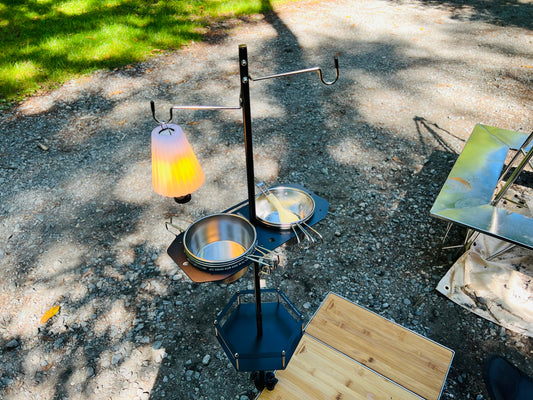

What kind of tableware (cookware) do I need?
First, let's start with choosing the materials.
Typical materials include aluminum, stainless steel, and titanium.
| price | lightness | Ease of use | |
| aluminum | ◎ | 〇 | 〇 |
| stainless | 〇 | △ | ◎ |
| titanium | △ | ◎ | △ |
Aluminum is relatively lightweight and has high thermal conductivity, making it less likely to burn when cooking simmered dishes.
Many of them are inexpensive, making them ideal for taking your first step.
Stainless steel is slightly heavy, but it's sturdy and won't deform even if handled a bit roughly.
The stainless steel's luster is also appealing, and if weight isn't a concern, it's a top contender.
Titanium is incredibly light and strong. It's a great option when you want to minimize the weight of your gear, such as during mountain climbing. While many titanium products are expensive, the satisfaction they provide in terms of ownership is also a major draw.
However, its low thermal conductivity means that heat doesn't spread evenly across the bottom of the pot, making it prone to burning. While using a burner pad can help, on its own, it's only really useful for boiling water.
Which set should I choose?
If you're thinking about starting camping and are wondering what kind of tableware you should get, you can't go wrong by choosing a set that includes a deep pot and a frying pan.
With this, you can cook rice, boil it, and bake it.
Most lids can also be used on frying pans.
If you're dining alone, choose a single set; if you're dining with family, choose a set that includes individual plates for each person.
For children, prepare stainless steel or aluminum items.
Paper plates and plastic plates are too light and will blow away in even a slight breeze. Paper plates become trash, and plastic plates are difficult to clean.
I think solo cooking isn't necessary because you eat directly from the pot.
Parents can enjoy a relaxing drink while enhancing the atmosphere with wooden dish plates.
Recommended tableware (cookware) sets
Coleman Packaway Solo Cooker Set
This is a Coleman cookset designed for solo use.
It's made of aluminum, has a slightly deep lid, and can also be used to warm soup.
The deep pot has measuring marks to help with measuring. It also has a pouring spout, showing attention to detail.
Hack Montana Outdoor Cookware 4-Piece Set
This product includes a set of large and small pots and a frying pan.
This is perfect for those who want to enjoy cooking even when solo camping, or for camping with one or two people.
Although there are many pots, they can be stacked inside each other (this is called stacking), so they don't take up much space when stored, which is another attractive feature.
Snow Peak Titanium Trek
This is a titanium cooker for solo use.
As mentioned earlier, since its primary function is boiling water, it's a viable option if weight is a top priority.
Furthermore, applying heat gives the titanium a unique "burnt color," adding to the enjoyment of using it over time.
CAPTAIN STAG Laguna Stainless Cookware Set for BBQ (Barbecue)
Stainless steel, suitable for 3-4 people.
This set includes a kettle, making it the perfect product for families.
This product is also stackable, so despite its size, storage is not a problem.
I can picture a scene where a family cooks rice and eats curry together.
How to wash dishes
You might think, "Just wash it with regular dish soap," but since we've come all the way to nature, we'd rather use an environmentally friendly washing method if possible.
1. Eat neatly.
I don't want even a little bit of leftover food going down the drain.
Of course, it's important to avoid leaving food uneaten, but it also reduces the amount of washing up and helps cultivate a sense of gratitude for food.
2. Wipe off
After eating, wipe it clean with a tissue.
By doing so, we can reduce the amount of detergent we use, which in turn reduces our impact on the environment.
You don't need wet wipes. If you wipe it up immediately after eating, you can use a regular tissue.
I am using toilet paper.
This allows you to precisely control the amount you use, and when wet, it becomes smaller than a tissue, reducing waste. Of course, it can also be used for its original purpose.
3. Use detergent minimally.
To wash them, fill the largest pot with water and wash them in that water. Turn off the tap water while you do this.
Unless the stain is really bad, it will come off with water.
They also sell sponges that claim to clean with just water.
LEC Gekiochi-kun Cube Melamine Sponge (30 pieces)
I use detergent for stubborn stains and as a final step.
As mentioned earlier, plastic containers are difficult to clean of grease and oil, which means you end up using more detergent.
4. Rinse
When rinsing, use as little water as possible.
If you have a pot, put all the dishes in it and rinse them while they soak.
If you don't have a pot, you can stack the dishes on top of each other, from the largest plate to the smallest, and rinse each one individually on top of the stack.
By doing so, you can use the rinsing water to wash away some of the soap suds from the plate below.
How to dry dishes
While you might want to use a dishcloth to wipe things down, if you drop it and sand gets on it, it becomes unusable. Also, items with only one use aren't suitable for camping, so tissue paper comes in handy here as well.
After washing the dishes, shake off the water and wipe them dry.
Then, place them on the table, stacking them from smallest to largest.
If you're worried about insects, you can buy a net for storing dishes, but it's bulky, so just put them in a laundry net from a 100-yen store.