
How to split firewood using a hatchet
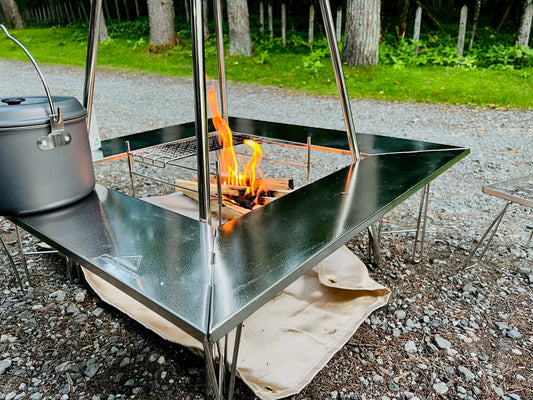
The best part of camping: a campfire.
Let's start with the first step: the hatchet used for splitting firewood.
This time, we're talking about firewood sold at home improvement stores or campsites, not branches or fallen trees found at the campsite.
Finally, we also recommend axes, which are more suitable for thicker trees than those that can be handled with a hatchet.
Please watch until the end.
Firewood splitting procedure
First, there's a place to stand the firewood upright when splitting it.
When splitting firewood on concrete, if the force is too strong and the hatchet hits the concrete, the blade will chip.
However, when hitting it on soil, the force of the blow causes it to sink in, so the force isn't transmitted properly and you can't break it.
Therefore, I use the remaining unsplit firewood, the kind with as many flat surfaces as possible, as a base, and do the firewood splitting on top of it.
Once you're ready, let's start breaking it open.
- Place the firewood upright on the stand.Holding the machete in his dominant hand, place it against the top edge.
- Prepare a piece of firewood that is easy to grip and hold it in your other hand.
- heldHit the back of the hatchet with a piece of firewood.Then the hatchet will bite into the firewood, and if you keep hitting it, it will split.
This taskIt's called "batoning"..
Things to be careful of when splitting firewood
It's not difficult if you follow the instructions, but if you let your guard down, it can lead to serious injury. Prepare thoroughly and enjoy it safely.
Put on gloves.
It's not just any material that will do. Since this is a dangerous task involving striking with a blade, the hatchet and the firewood being struck must not slip.Gloves with good gripLet's choose.
Leather gloves are ideal, but if you don't have any, use work gloves with yellow non-slip grips. If you don't have those either, wear regular work gloves on the hand that will be hitting.
The reason for wearing a regular work glove only on the side you're hitting is that when you hit the wood hard, splinters are more likely to get stuck in your skin.
Furthermore, gripping a machete with work gloves makes it slippery and very dangerous.
Check your attire.
Not just when splitting firewood, but when camping...Long sleeves and long pants are the basic attire.The same applies when splitting firewood.
When firewood splits forcefully, it can hit your legs or arms, potentially causing unexpected injuries.
Shoes. When splitting firewood, you might pass through it. Sandals are dangerous in that situation. Sneakers are preferable.Boots with stiff toesThese are good options.
How to choose a hatchet for splitting firewood
What size do I choose?
The size isBlade length is typically around 16-20 cm.And it's a size that's easy for beginners to handle.
There are two types of hatchets: those with a V-shaped blade cross-section, called "double-edged," and those with a single-edged blade shaped like the Japanese katakana character "re."
Double-edged tools are used for splitting firewood, while single-edged tools are used for peeling bark from firewood or cutting branches.
For those who don't want to carry too much luggage, there are also compact sizes available.
Recommended wood-splitting hatchets
So, how do you actually choose a machete? Let me introduce the best-selling one and the one with the best cost performance.
Koten Steel-edged Mini Chopstick-Attached Machete 130mm C-70
| Total length (cm) | 28.5 |
| Blade length (cm) | 13 |
| Blade width (cm) | 6.5 |
Koten Steel-edged Mini Chopstick-Attached Machete 130mm C-70 Recommended Features
This is a double-edged hatchet suitable for splitting firewood.
It is made using a forging method, where steel is wrapped around soft iron and then hammered and stretched, resulting in a material that is hard and resistant to chipping (breakage).
Since it's made of steel, you can sharpen it when it gets dull, allowing you to use it for a long time and develop an attachment to it.
The tip has a protrusion (like a chopstick) to prevent the blade from chipping even when struck against hard ground.
That doesn't mean you can treat it roughly, but you can baton it to your heart's content while taking safety precautions into consideration.
It's great that you can split thin pieces of firewood and shave wood even on gravel surfaces without worrying about chipping the blade (^-^)
If you apply too much force, the blade might hit the gravel in deeper sections, but the blade is sharp, so you can easily split moderately thick firewood with light force!
From Amazon reviews
Bohken Club (BOHKEN CLUB) Natatonoko Small NS-180
| Total length (cm) | 35 |
| Blade length (cm) | 16.5 |
| Blade width (cm) | Not specified |
Bohken Club (BOHKEN CLUB) Natatonoko Small NS-180 Recommended Points
This set includes a hatchet and a saw, making it a great value product.
Unlike the previous hatchet, this one doesn't have a blade protector to prevent chipping, but that's not a problem if you're using it at a campsite with a dirt ground.
Some people prefer knives without tines because they are easier to sharpen.
Although the blade width is not specified, batoning can be easily performed with this tool.
Unlike knives, there isn't extreme variation between different machetes.
For fire pits designed solely for burning firewood and not for cooking, commercially available firewood may be too long to fit.
In such situations, having a saw makes it easy to adjust the length.
You can also do it with a machete, but it requires physical strength as you have to smash and break it.
I'm an amateur trying to use it for batoning by trial and error, but I'm able to split firewood without any problems.
When preparing firewood for a wood stove, if the pieces are too long, they will stick out, so you may want to cut the firewood shorter.
Since I have a saw, I can cut it with a lot of force.
A hatchet is good at splitting firewood lengthwise, but it's not good at cutting it crosswise, so this comes as a set with both a hatchet and this tool.
I think this is a very easy-to-use product.
The price is also low, so it offers great value for money.
From Amazon reviews
A hand axe is better for splitting large logs.
Recommended hand axes
Sometimes, commercially available firewood contains pieces that are too thick to handle with a hatchet.
In such situations, an axe becomes absolutely necessary.
In addition, for those who saw someone splitting firewood with ease at the neighboring campsite and thought, "I want to try that!", I'd like to recommend an axe.
Husqvarna Hand Axe, 38cm, Made in Sweden
| Total length cm | 38 |
| Blade length cm | 8 |
| weight kg | 1 |
Husqvarna Hand Axe 38cm, Made in Sweden - Recommended Features
Crafted from high-quality Swedish steel and forged by skilled artisans, these knives achieve a perfect balance of hardness, toughness, and sharpness.
The handle is made of American hickory wood, and its exquisitely curved shape reduces fatigue.
Furthermore, while it's designed to be easy to use with one hand, it's also easy to control when using both hands, allowing you to swing the axe down precisely where you want it.
A luxurious leather cover is included.
When storing it, put a cover on it and take precautions to ensure its safety.
Storing it in a cover prevents it from getting scratched by bumping into other tools or the blade from chipping.
I was using Columbia Knives and Mora Knives for batoning, but the wood wouldn't split easily, and in the end, the handle of the Columbia Knife broke...
Using the Husqvarna I'd always wanted to try made me wonder what all my previous struggles were for.
For me, it's perfectly fine straight out of the box!
Also, it seems like you'll need to be very careful when using it, especially with your fingers and toes...
From Amazon reviews
Hewflit Hand Axe
| Total length cm | 26 |
| Blade length cm | 10 |
| weight kg | 0.3 |
Hewflit Hand Axe: Recommended Features
This is a very lightweight one-handed axe, weighing only 300 grams.
Because it's lightweight, it's not as effective as a Husqvarna when it comes to splitting firewood using its weight, but its small size and light weight give it an all-around feel that's similar to a hatchet.
Furthermore, the included case (called a sheath) is made of nylon, making it tear-resistant and durable. The sheath also has a belt loop, so you can carry it hanging from your waist.
Walking through the forest with an axe hanging from your waist...it sounds exciting, doesn't it?
The base of the blade has 10mm, 14mm, and 19mm hex wrenches attached, which can be very useful in a pinch.
Made of stainless steel, it's rust-resistant and maintains its sharpness for a long time. If it starts to dull, you can restore its sharpness by lightly sharpening it with a 1500-grit whetstone (this is called touch-up).
If you use it as is, your hand will probably hurt, so I wrapped it with paracord, which made it easier to hold. It's light and easy to hold, so I think it's very practical. The blade cuts reasonably well even when it arrives, but I lightly sharpened it with a whetstone. Because the blade is thin, it bites in easily, and you can use it to cut like a machete or like a knife. For firewood, if you bite in from above and then strike it, it works quite well. It seems better to sharpen the blade to be a bit thicker. It's not overkill, and I like that you can customize it and have fun with it.
From Amazon reviews
summary
There are several ways to stay warm while winter camping, but burning firewood is perhaps the most rustic and enjoyable of them all.
For information on stoves for winter camping, please see the article below.
For heating purposes, a kerosene stove is easier than a wood-burning stove or campfire, and for cooking, a gas burner is more convenient.
However, enjoying the inconvenience is part of the fun of camping. The products I've introduced today can add a little bit of enjoyment to that inconvenience.
I placed a Sierra cup of beer on the snow and sipped it while batoning. Beside me, my children and wife were roasting marshmallows and building a snowman.
So, why don't you go on the best camping trip ever?