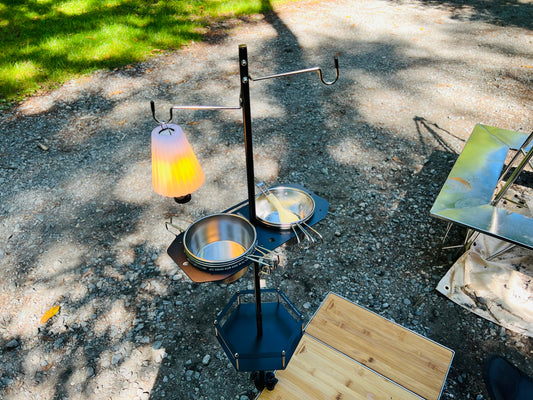


How can I enjoy both solo camping and family camping? Can I use the same equipment for both?
Whether you enjoy solo camping or family camping, or if you enjoy one or the other and are thinking about trying both, I've compiled some helpful information.
This article is based on interviews with people in their 40s who enjoy both solo and family camping.
- You can find out which equipment can be used for both solo camping and family camping.
Solo camping is about enjoying freedom.
Family camping is about enjoying the growth of your family.
Contents of this article
- Differences between solo camping and family camping
Solo camping is freedom
The greatest appeal of solo camping is undoubtedly the freedom it offers.
When and where are you going? What are you taking and what are you leaving behind? What about food and alcohol? What will you do when you get there?
Everything is based on your own decisions and responsibility. If you fail, you deal with it yourself; if you make a delicious meal, you get to enjoy it all to yourself. The same goes for a sky full of stars.
You're not lonely at all. Let's face yourself head-on.
Family camping strengthens bonds and fosters children's growth.
In contrast, family camping shows changes with each subsequent trip.
Basically, we can only go camping with the family during the Obon holiday (because we live in a northern region, we can only go camping with the kids in the middle of summer), but when I think back to how the kids were the previous year, I'm amazed at how much they've grown.
From the excitement of seeing the tent on their first camping trip, to hammering in pegs and setting up ropes...
I was inspired by the "Illustrated Guide to Little People" and went into the bushes with a net, but I became afraid of insects and couldn't walk alone anymore.
(Note: [The Little People Encyclopedia]: A media mix content in which a boy goes searching for "little people" hidden in nature. It became a huge hit about 10 years ago.)
During our last camping trip, she made curry sandwiches using a hot sandwich maker.
My wife does the cooking, just like when I'm at home, but I'm happy and feel a little proud when there are occasions where she relies on me, even just a little, for things like handling the burner or cutting vegetables with a knife that's different to use than a kitchen knife.
I take the lead in setting up the tent. It's a five-person tent, so I can't set it up by myself; I need help pulling and supporting it.
I'd like to show leadership, but I always make mistakes somewhere along the line. My children and my wife make mistakes too.
But perhaps because I'm surrounded by nature, I can laugh off everything. The forest and the sea absorb any frustrations.
Tools that can be used for multiple purposes
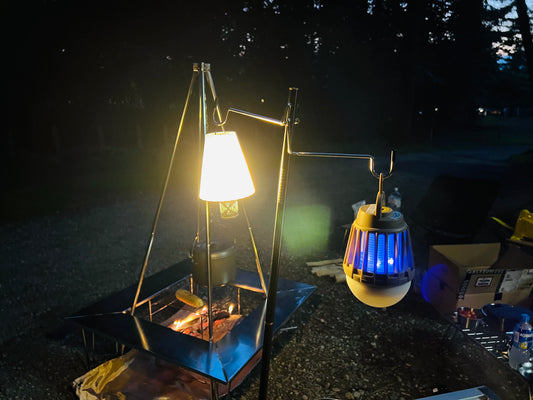
• Lighting fixtures such as lanterns
Strong light actually creates more shadows, and your eyes can't adjust, so dark areas remain dark indefinitely.
It's common to carry three lanterns: a main one, a backup one, and a headlamp for going to the toilet.
I realized that with minimal light, you can see a lot even in the dark, so now I only bring things that provide a faint light.
In my case, I found my main lantern gathering dust at an acquaintance's house and was given it to me.It became usable again just by wiping off the soot. I think it's a very durable item with few elements that could break, so I want to cherish it for a lifetime.
I use a candle lantern as a secondary light source.
I saw a fellow biker at a campsite using just this as his light source, and I was so drawn to its ruggedness that I decided to buy one myself.
It's just a candle, so it doesn't function very well as a light source, but it creates a fantastic atmosphere.
A headlamp leaves both hands free, preventing falls and injuries in the dark. While the campsite prioritizes atmosphere, using the toilet at night is very inconvenient with both hands occupied, so I use this.
・Tarp
I use it to protect myself from the rain. I live quite far north, but summer in the north is fleeting. If you try to escape the heat, it'll be over before you know it.
I wanted to soak up the strong sunshine, but if it rained, I wouldn't be able to do anything, so I brought in a tarp.
This meant that even in light rain, I didn't have to stay cooped up in the tent, and I even had the luxury of enjoying the sound of the rain.
·chair
I found it at a second-hand shop.
It's incredibly comfortable to sit on. However, if the ground is soft, the legs will sink into the soil, so it's a good idea to place empty cans or something similar underneath.
It's also convenient to have a mat to sit on the ground in addition to a chair.
I impulsively bought them online because they were being sold as a set of two for about 500 yen including shipping.
Thanks to the urethane, it helps to mitigate the temperature of the ground, and when folded, it can be used as a pillow.
When camping, I often have trouble falling asleep because I don't have a pillow, but this has solved that problem.
Burner and cooker
I recommend the Coleman separate-type burner.
I'm using an older model, the Coleman HPX TABLE TOP STOVE Model 4020, but I think the current models would have the following burners.
I bought it soon after I started camping. I remember buying it because I didn't know anything back then and just wanted the right atmosphere.
The advantage of a separate pan is that it makes cooking easier. It's recommended because it's stable even with a pot on top.
In my case, I also use another stove, which is a gasoline-powered burner.
When I cycled across Hokkaido, I took the aforementioned Coleman stove with me, but every time the gas was about to run out, I had to look for a hardware store.
My movements were so restricted that it could be considered one of the main reasons for my trip.
So, thinking there would be plenty of gas stations along the national highway, I bought this one that uses regular gasoline.
While precise heat control isn't possible, you can cook rice with it once you get the hang of it.
These types of burners are called multi-fuel burners. Although they have the drawback of not allowing for flame adjustment, they are popular models because they can be used reliably even in winter.
Fuel bottles are sold separately, so you can add extras as spares.
I use a mess kit as a cooker.
This is also all about atmosphere. When I first started camping, there was hardly any internet or even specialized magazines, so I chose everything based on the overall feel.
This mess kit is one of them. It's been used a lot and is quite dented, but it doesn't seem to be breaking, so I'll keep using it for a while longer.
I also use Sierra cups as plates. Sierra cups are versatile and can be used as plates, cups, and bowls, so I use them for all my meals.
It takes some getting used to to hold it, but the coffee you drink from it is exceptional.

Tools that cannot be used for multiple purposes
·tent
Family camping tents tend to be large, making them difficult to set up alone.
However, the first collaborative task you undertake upon arriving at the campsite, building the tent together, deepens the sense of unity that follows.
·table
I'm a "ground-sitting camper" who doesn't use a table when solo camping, but when I go with my family, I really want one.
However, when it comes to family-sized versions, they inevitably become larger, making them inconvenient for solo use.
• Chairs (for 2-3 people)
Two-seater chair
When I first started camping, I thought it would be cheaper to buy a two-seater than to buy individual seats, so I went with a two-seater.
It folds down very thinly, so it's easy to store, but it's still too big for solo use. My kids are using it now.
・ Fire pit
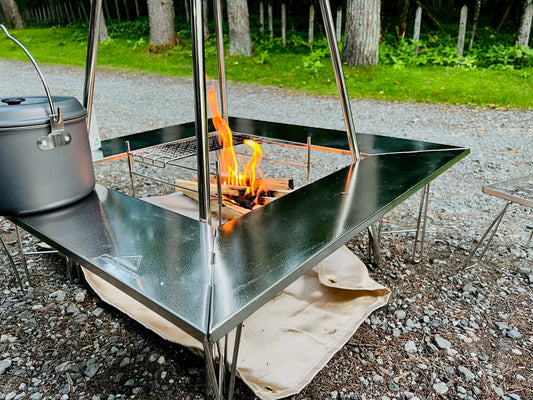
When you think of camping, you think of barbecue, and after that, a bonfire, so I bought this.
However, since it's designed for family camping, it was too big. I found one that's suitable for solo camping, so I'm using that instead.
Let's try family camping too!
Those of you who have read the section on the differences between solo camping and family camping may have already noticed, but it might be best to think of these two as completely different things.
In a sense, solo camping is a time when all five senses are sharpened and you can confront yourself.
In contrast, family camping is an "event" where you can really feel your child's growth.
There's no need for your father to boast about his strength.
How to drive in tent pegs, how to wash dishes with little water, how to start a fire, how to play in nature. With each session, the things children can do and the things we can entrust to them increase, and they change.
As I gaze at the campfire and watch our exhausted children sleeping peacefully with my wife, I am certain that we have made the right decision this past year.
Family camping might be a space where you can realize that you are growing as a parent at the same time as your children are growing.