
I burned a hole in my brand new jacket with a campfire.
Choosing the right clothing material is crucial when making a bonfire.
This article will tell you the following:
Materials suitable for campfires
Outerwear I want to wear when sitting around a campfire
The perfect outfit for camping! To avoid burning holes in your clothes with a campfire! The perfect outfit for camping! To avoid burning holes in your clothes with a campfire!
- You'll learn what kind of clothing is suitable for a campfire.
What materials (fabrics) are susceptible to damage from campfires?

The materials used in apparel these days are synthetic fibers, including nylon.
The same applies to camping and other outdoor activities.
Considering how to deal with sweat,Synthetic fibers are excellent materials, but they are not ideal for enjoying a campfire..
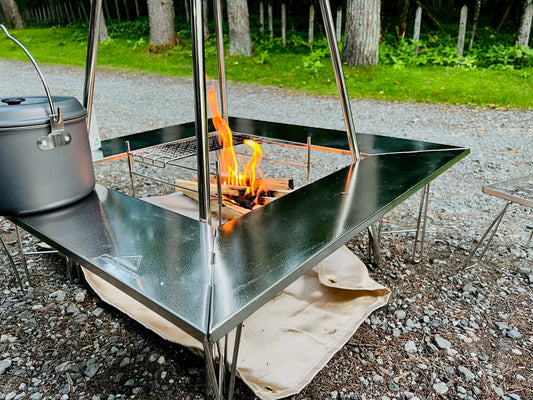
Sparks from a campfire fly, so holes can be burned in the material even without direct contact with the flames.
Yes, synthetic fibers can easily get holes in them, even from sparks.
What happens if you wear synthetic clothing around a campfire?
It's not so much that it's vulnerable to campfires, but rather that it's vulnerable to heat in general.
Heat doesn't have to be the kind of heat that makes something glow red and impossible to approach; even the heat from a tiny spark is the same thing.
If you're wearing synthetic clothing and are near a campfire, sparks can easily burn holes in it.
If you're wearing layers of clothing while camping in the middle of winter, sparks are less likely to reach your skin, but if you're wearing spring or autumn clothing, they can easily get on your skin.
Sparks aren't the only thing to be afraid of!
It's scary to think of getting burned by sparks directly touching your skin, but the heat from the flames can also harden the surface of your clothes.
The heat of the flames is also frightening.That's right.
When camping on a cold day, you'll often find yourself wanting to warm yourself by getting close to the campfire.
While you can be careful to prevent sparks from burning holes, the heat that you feel after a delay is actually more dangerous.
When you feel warmth on your skin, the surface of your clothing may actually be hot.
With synthetic fibers, material changes such as hardening occur before they burn.
It's sad when clothes from expensive outdoor brands get ruined.
So what should we do?
The key is in choosing the right materials.
Enjoy a bonfire with heat-resistant materials (fabrics).
Material resistant to campfire (heat)What exactly is that?
The answer is cotton and wool.is.
I used to be a welder, exposed to sparks and high temperatures, but my work clothes were 100% cotton.
Cotton work clothes are fine even when working near temperatures that melt iron (1000-1300°C).
Conversely, if I forget my work clothes at the beginning of the week and have to wear synthetic work clothes instead, they'll be completely worn out by the time of my morning break.
If you wear cotton underwear, you won't get burned even when working in a place where sparks might land on you.
However, the weakness of cotton is that sweat doesn't evaporate easily.
It has the drawback of being hot in the summer and cold in the winter.
theWool compensates for its weaknesses.is.
The material that is resistant to both heat and sweat is wool.
Wool fibers have scales called scales, which help maintain a moderate level of humidity inside the garment.
Furthermore, it is highly heat-resistant, making it a suitable material for campfires.
This is because wool fibers contain nitrogen (16%) and moisture (15%), and have a high ignition temperature, making them difficult to burn.
Merino wool, a material recently seen in undershirts, refers to a type of sheep called "merino."
Wool products tend to be expensive, but once you understand the secrets behind their functionality, it's all worth it.
Wool and cotton are heat resistant.
| fiber | Heat of combustion (kcal/g) | Ignition temperature (°C) | Melting point (°C) |
| Wool | 4.9 | 570-600 | It turns into charcoal instead of melting. |
| Cotton | 3.9 | 260 | It turns into charcoal instead of melting. |
| acrylic | 7.6 | 470-530 | 240-320 |
| polyester | 5.7 | 490-560 | 250-290 |
| nylon | 7.9 | 490-580 | 160-260 |
| polypropylene | 11.1 | 570 | 160-170 |
Looking at the table, it might seem that polypropylene has a higher ignition temperature and is less flammable than cotton.
However, its low melting point presents functional problems.
on the other handWool has a high ignition temperature and a low heat of combustion, second only to cotton, making it a difficult material to burn.That seems to be the case.
However, it could be an option for use in extreme conditions, but the materialThe price is high, and the initial investment costs will be substantial..
Therefore, if you only camp or have a bonfire a few times a year, I recommend wearing synthetic innerwear and cotton outerwear.
Although it has the lowest ignition temperature, it doesn't spread because it carbonizes before it can burn.
Explanation of terms
The table above is Nikke Group, Homepage This is an excerpt, so it contains some terms that may be a little difficult to understand.
This section explains the terminology used.
- Heat of combustion: This refers to how intensely a fire burns when it starts. A higher temperature means greater damage.
- Ignition temperature: This refers to the amount of heat required to ignite a material. A higher ignition temperature means the material is less likely to burn.
- Melting point: The temperature at which a material melts without burning. Some fibers melt without burning.
Recommended clothing for men for bonfires
The North Face Rearview Full-Zip Hoodie
Main material: Body T/C brushed back: 80% cotton, 20% polyester
Material composition: Main body: T/C, Brushed lining: 80% Cotton, 20% Polyester
This is a cotton hoodie from The North Face.
Since it's 80% cotton, you can simply brush off any sparks that might get in the way.
Since it opens in the front, you can open it to adjust if it gets too hot during the day.
The fleece lining provides warmth and comfort even when it gets cold at night.
Containing 20% polyester, this product is perfect for outdoor activities where quick-drying properties are required.
(Grip Swany) Fire Parka IV
Material: 100% Cotton
The overall silhouette is loose and baggy.
It doesn't offer much warmth, so wear a down jacket or sweater underneath if it's cold.
The material is a bit rough, but that also adds to the outdoorsy feel, which is enjoyable.
We also have trousers.
GRIP SWANY Fireproof Pants
Material: 98% Cotton, 2% Polyurethane
Due to the flame-retardant treatment, a drawback is that the material may have a noticeable odor when new.
The flavor will fade over time, so please understand this before purchasing.
The intensity of the scent seems to vary greatly from item to item, so if you're concerned about it, returning or exchanging it might be a good idea.
ALOWALA Cotton Jacket
Material: 100% Cotton
The image shows a camouflage pattern, but it also comes in khaki and apricot colors, which are easy to match and highly recommended. Its appeal lies in its popularity with both men and women.
Something a little cute too.
It's a poncho style, but you can tighten the hem to prevent wind from getting in when it's windy.
The pockets on the stomach are connected on both sides, so you can access them even if one hand is occupied.
Recommended clothing for women for bonfires
Workman Cotton Anorak Parka S020A 100% Cotton Women's
Material: 100% Cotton
Workman is focusing on developing outdoor products.
Originally a workwear store, we are strong in these kinds of products.
The overly simple design may not appeal to everyone, but this is reflected in the price.
It has all the features you'd want, like sleeves that can be tightened with Velcro and hand warmers.
GRIP SWANY Fireproof Monster Parka 2.0
Material: Outer fabric/100% cotton, Lining and filling/100% polyester
When it comes to campfires at campsites, Grip Swany is the go-to choice.
Since it's 100% cotton, you don't have to worry about sparks from it.
It's padded, so you can stay warm even in cold weather.
NANGA Bonfire Down Jacket
Material: Outer fabric: 93% polyester, 7% aramid
Lining: 100% Nylon
Filling: DX/90% Spanish duck down, 10% feathers (760FP)
Corduroy: 97% cotton, 3% polyurethane
Ribbed section: 95% polyester, 5% polyurethane
This is a campfire outer jacket from Nanga, a well-known manufacturer of sleeping bags.
As expected from Nanga, the jacket is filled with 760FP down.
It might be too warm if you're sitting right next to a campfire, but it's a welcome sight in the middle of winter.
The corduroy fabric and contrasting color design will appeal to women's sense of style.
summary
So there are materials that are safe to use over a campfire, huh?
Wool is ideal because it's flame-resistant and absorbs sweat.
Let's make a list of what to wear when sitting around a campfire.
Wool: Ideal because it's flame-retardant and absorbs and wicks away sweat. But it's expensive.
Solution: A combination of absorbent innerwear and a low-cost cotton outer layer.