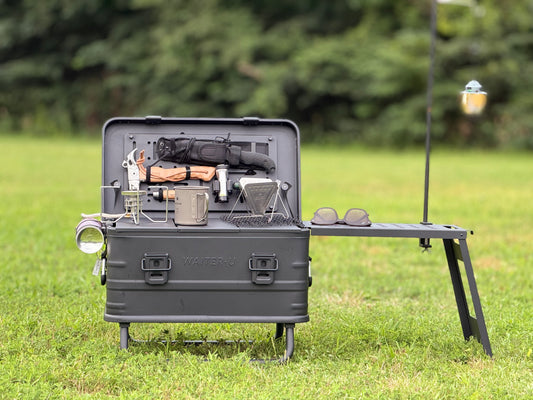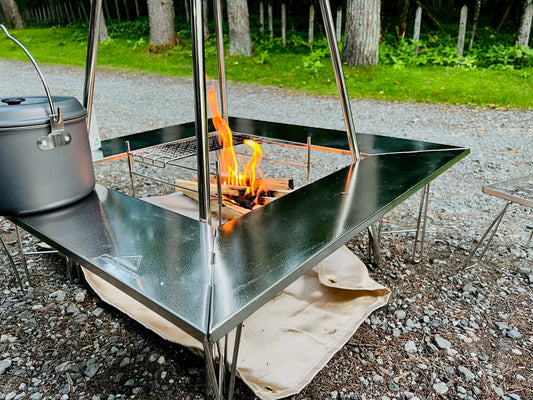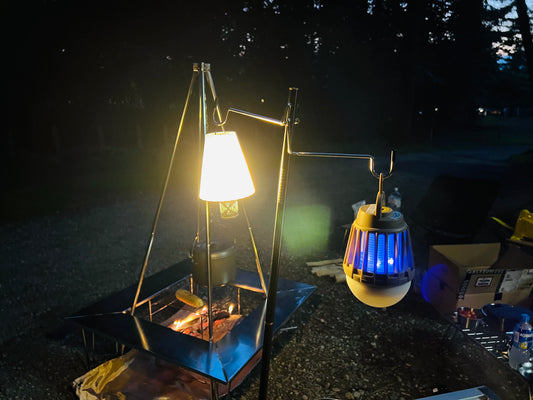

Hi, I'm Tsukui, and I run "The Camping Lounge WAITER-U," a cafe in Shimokitazawa that feels like a campsite. We have lots of customers every day, and because of the location, most of them are young people. They're not hardcore campers, but rather people who want to enjoy camping more casually, or who just like looking at camping gear. That's why when I talk to customers at the cafe, I often get asked questions about camping.
How much food do I need for solo camping?
Among them, the most common are,
"How much food should I bring for solo camping?"
That's the question. My answer is always the same.
"I think it would be fine to source it locally."
Actually, it's more fun that way, and it makes my luggage lighter.
My favorite way to find ingredients: roadside rest stops
My favorite thing to do is to research roadside rest areas near campsites beforehand, get up a little early in the morning, and stock up on groceries there. Many of them close around 4 pm, so the key is to get there in time.
What you can get there are fresh vegetables and meat, and things you absolutely can't find in the city. I think getting those things is the ultimate luxury. Finding vegetables grown by local farmers and specialty products unique to the region is like a treasure hunt, and it's really exciting.
The menu is decided by inspiration.
You can decide on the menu based on inspiration at the moment. Pick up some vegetables you wouldn't normally buy at a roadside station, like shallots, and think, "Let's make something with these." You can always look up a recipe later, and it'll work out somehow.
Just the other day, I found some mushrooms I'd never seen before at a roadside rest stop and bought them on impulse. I wasn't sure how to cook them, but I decided to make ajillo with them, and it was incredibly delicious. Discovering new ingredients is one of the great joys of camping.
The basic rule is to source ingredients locally, and if you're unsure what to get, go for "meat"!
The basic principle is to source food locally. That's my food procurement strategy for solo camping.
If you're really unsure what to cook, just buy some good quality meat locally and grill it – that's a guaranteed success. That's what camping ultimately comes down to. Even simply grilling it with salt and pepper tastes exceptional when cooked over charcoal.
Use only the amount of ingredients you can eat.
Regarding the amount to buy, when solo camping, you tend to buy a lot of things out of anxiety, but with camping, it feels good to use everything up on the day. There's no waste, and less trash.
If you have leftover food, it's a hassle to take it home from a campsite that doesn't have a refrigerator. It's best to buy only what you can eat and buy more if needed.
Emergency food supplies for just such an occasion
If you run out, I recommend keeping emergency food on hand. Instant rice that you can eat just by adding hot water, like Montbell's Risotto series, is very convenient. Having about three different kinds on hand will give you peace of mind.
I once ran out of food while solo camping. That's when the instant rice I had as emergency rations came to my rescue. Being able to eat a warm meal is so comforting, both mentally and physically.
Everything tastes delicious at a campsite!
It's strange how instant food that might seem a bit lackluster to eat at home after work tastes absolutely delicious at a campsite. I think you'll feel more satisfied if you make good use of a small amount of emergency food rather than buying a lot of ingredients and letting it all go to waste.
Food tastes so much better when you eat it in nature. The coffee you drink in the morning, the marshmallows you eat around the campfire—they all have a special taste that you can only experience at a campsite.
"The Camping Lounge WAITER-U" is a place where camping enthusiasts gather.
At The Camping Lounge WAITER-U, we want to create a place where people who want to start camping, veteran campers, and all kinds of people can connect through camping.
If you have any problems with camping, please feel free to ask me anytime. Let's have a great time chatting about camping over some delicious coffee!
I look forward to your continued support!