Having a little bit of useful knowledge can double the fun when camping.
Learning some little-known facts can be really helpful when you're in a bind.
This article compiles 16 interesting facts you should know before going camping.
We'll introduce some useful tips for each situation, so please take a look.
- You can learn some interesting camping trivia.
Contents of this article
8 Tips for Setting Up and Enjoying Camping

First, let's look at some useful trivia to know when setting up camp or going for a nature walk.
When you lack tools, make use of nature's resources.
Have you ever arrived at a campsite only to realize you're missing some essential equipment, causing you a lot of trouble?
In such situations, utilizing the blessings of nature can sometimes help.
For example, if you forget your tent peg hammer, you can use a stone lying around as a substitute.
If you get lost while trekking, check your watch to determine your direction.
When you go trekking while camping, you might get lost.
On a clear day, if you have a watch, you can check the direction and find the way home.
When you point the hour hand of your watch towards the sun, the direction between the 12 o'clock position and the hour hand roughly points south.
Since you can determine direction even without a compass, you'll be able to escape from difficult situations.
Let's make a pillow out of clothes to reduce luggage.
Camping gear tends to be bulky, but there are many ways to make it more compact.
For example, pillows are a prime example of bulky items, but you can substitute them with clothing you bring camping.
Bundle your clothes together and put them in a stuff sack, and they'll instantly transform into a comfortable pillow.
The stuff sack is waterproof, so you can use it with peace of mind even when it rains.
Place the lantern far away to deter insects.
During summer camping trips, insects can be a real nuisance.
Nocturnal insects such as moths tend to gather in bright places, so if you have a light on in your tent, they are likely to come inside.
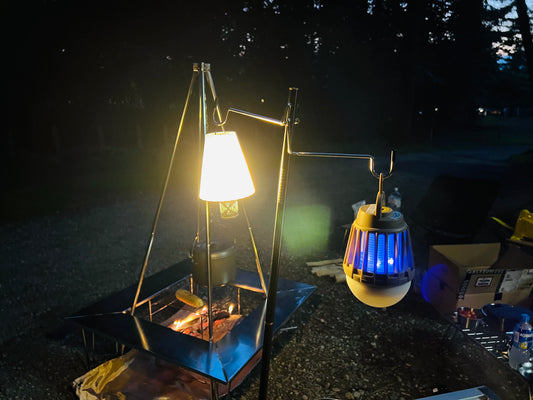
For insect control at night, it's recommended to place a lantern a short distance away from your tent.
Insects are attracted to the lantern, so the inside of the tent remains a comfortable environment.
Related articles
・Recommended lanterns for camping (Coleman, GENTOS)
In the hot summer, set up your tent in the evening.
Setting up tents during the daytime at summer camps is extremely difficult due to the heat.
In such cases, it's recommended to start setting up camp in the late afternoon as sunset approaches.
Check the timing of sunset and start working backward from there so that you can finish setting up before it gets dark.
Use a hot water bottle to combat the cold.
Cold weather is a major concern when camping in winter.
Making a hot water bottle is an effective way to ward off the cold.
Simply filling a plastic bottle with hot water will create a makeshift hot water bottle.
Make sure to close the lid tightly to prevent the hot water from spilling.
Having a sturdy bottle, such as a Nalgene bottle, on hand will make things even more convenient.
Place your feet towards the entrance of the sleeping bag.
When laying out sleeping bags inside the tent, it's safest for everyone to point their feet towards the entrance.
It would be terrible if you needed to go to the bathroom after everyone had fallen asleep and accidentally stepped on someone's head.
By having everyone point their feet towards the entrance/exit in unison, it becomes easier to enter and exit, and the risk of accidentally kicking someone's head is reduced.
Prepare a large plastic bag for rain protection.
Having a large plastic bag on hand can be useful for protection against rain.
You can put items that have gotten wet in the rain into a bag and take them home.
Since it can be difficult to figure out how to carry wet items home, it's a good idea to prepare a large plastic bag of 45 liters or more.
8 Useful Tips for Cooking While Camping

Next, I'll introduce some essential knowledge about cooking.
Pre-cooling a cooler box improves its cooling performance.
Cooler boxes used to keep food and drinks cold will maintain their cooling power longer if they are pre-cooled beforehand.
First, chill the inside of the cooler box, then add the food and drinks that have been chilled in the refrigerator.
The trick is to cool the cooler box using water bottles or ice packs filled with cold water before packing in food and drinks.
Pre-preparation shortens cooking time.
To make camping meals go smoothly, it's helpful to do some of the prep work at home beforehand to save time.
Preparing ingredients at a campsite often takes more time than expected, reducing the time available for relaxation after the meal.
Preparing and seasoning ingredients at home, or cutting them so they're ready to cook, will allow you to proceed with cooking more smoothly.
Peel the skin with a plastic bottle cap.
Sometimes I forget my vegetable peeler, which makes preparing vegetables difficult.
Some campsites rent out vegetable peelers, but if they don't, you'll be at a loss.
In such situations, try using a plastic bottle cap.
You can peel ingredients by sliding the lid along its edge.
This technique can also be used to remove fish scales, so it's good to remember in case of emergencies.
Using potato chips as fire starter
When starting a fire while camping, you typically use firelighters.
However, you might realize you forgot to bring firelighters after arriving at the campsite.
In such situations, you can use flammable materials as a fire starter.
For example, potato chips brought as a snack are high in oil and highly flammable, so they can be used as kindling.
This is a handy technique that can be used even when the kindling twigs are wet from the rain.
Use cleanser to remove dirt from pots and pans.
When cooking in a pot over a campfire while camping, food can sometimes burn onto the pot and become difficult to remove even by scrubbing.
In such cases, applying cream cleanser to the outside of the pot before cooking will make it easier to remove the dirt.
If some dirt remains, using a cleanser to wash it will be effective.
Cleaning up after cooking with oil can be done by making candles.
When you fry food while camping, you might have trouble dealing with the oil.
In such cases, try making a candle with the leftover oil.
You can make a candle by placing a fuse, such as cotton string, into oil and then solidifying it with an oil solidifier.
This is a win-win method that allows you to create items to enjoy your camping night while also cleaning up.
Cleaning up after grilling is easy by grilling again.
After grilling, cleaning the grill is a real chore.
However, further heating the grill makes it easier to remove dirt, thus simplifying cleanup.
This is because most of the dirt on the net can be carbonized.
If you thoroughly heat the grill over charcoal, any dirt will turn into charcoal, making it easy to clean.
While it's easy to think that overheating the grill makes it harder to clean, the opposite is true; overheating actually cleans it better.
Wet wipes are a versatile item for camping.
Wet wipes are a handy item that comes in handy in many situations while camping, so be sure to bring some along.
During camping trips, there may not be running water nearby, which can limit opportunities to clean your hands.
Having wet wipes on hand is useful for maintaining hygiene, as you can wipe your hands while cooking or eating.
Choosing thick wet wipes makes them a versatile item that can be used for various purposes, such as wiping away dirt or as a pot holder.
summary
Knowing a little bit of trivia can be helpful when you're camping and need it.
Knowledge that initially seems surprising gradually becomes second nature.
Let's enjoy camping by acquiring various kinds of knowledge.