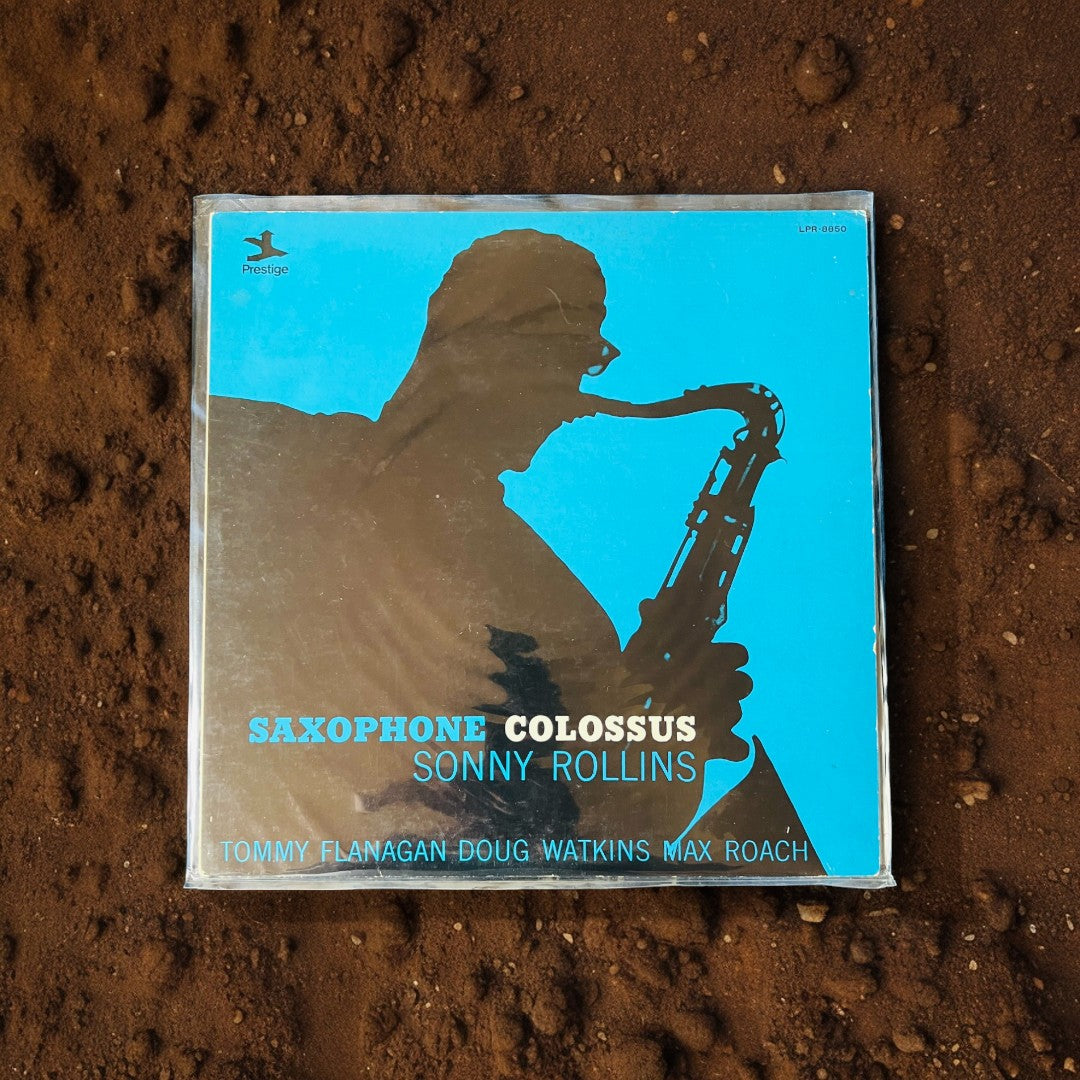
Today's playlist. For the 35th installment, we're featuring "Sony Rollins".
I bought it at Flash Disc Ranch, my favorite record store in Shimokitazawa.
This is a record store I've been going to ever since I first moved to Setagaya. It's popular because of its amazing point card system, which is valid as long as the store is open. Once you collect 50 stamps, you can buy any number of records under 15,000 yen for half price.
Sonny Rollins: The Jazz Giant, His Journey and Philosophy
Sonny Rollins, a saxophone giant who shines brilliantly in the jazz world, plays powerful, and at times delicate, tones that stir the hearts of listeners and are deeply etched into the history of jazz. His music is not merely a sequence of notes, but a cry from the soul born from the struggles and joys of life and an unyielding spirit of inquiry.
The Passion and Struggles of Youth: From New York to the World
Born in Harlem, New York in 1930, Rollins was immersed in music from a young age and began his professional career in his teens. In 1949, at the tender age of 19, he recorded his first original composition, "Audobon," showcasing a glimpse of his talent. In the early 1950s, he was greatly influenced by the innovative musicality of legendary trumpeter Miles Davis through their collaborations. "Oleo," written during this period, later became a jazz standard, and his talent as a composer also blossomed.
However, the young Rollins struggled with heroin addiction, a battle that cast a long shadow over his musical career. In 1950, he was arrested for robbery while purchasing drugs and served time in prison. He continued to face numerous arrests and rehabilitation sessions, walking a difficult path.
Saxophone Colossus: Establishing Fame, and Then Suddenly Retiring
In 1956, Rollins' music reached a new dimension with the album "Saxophone Colossus." This album is one of his signature works and includes "St. Thomas," a beloved jazz standard. The song, which incorporates calypso rhythms, reflects the influence of his Caribbean musical roots. After that, Rollins produced numerous masterpieces such as "Way Out West" and "A Night at the Village Vanguard," reigning at the pinnacle of the jazz world. However, despite his fame, he suddenly announced his retirement in 1959, shocking the music world.
The reasons cited for this sudden retirement include his dissatisfaction with his own playing and his disillusionment with the commercialized jazz world. Rollins chose to pause and reflect on himself and his music.
Revival and a New Challenge: A Fusion of Latin Rhythms and Free Jazz
After a two-year silence, Rollins resumed his activities in 1961, embarking on new musical challenges. He developed innovative sounds that transcended the boundaries of traditional jazz, such as "What's New," which incorporated Latin rhythms, and "Our Man in Jazz," which incorporated elements of free jazz. In particular, with "Our Man in Jazz," despite the simple trio formation of saxophone, bass, and drums, he made full use of improvisation to create free-spirited music.
In 1963, he made his first visit to Japan, captivating Japanese fans with his energetic performances and distinctive mohawk hairstyle. This tour became a source of new inspiration for him and had a significant impact on his later musical career.
Further evolution and musical exploration: fusion with rock and unaccompanied solo
In the 1970s, he ventured into electric jazz, and in 1981, he participated in the Rolling Stones' album "Tattoo You." He collaborated with Mick Jagger and Keith Richards, attempting to fuse jazz and rock. This collaboration demonstrates the breadth of his musicality and his inquisitive spirit towards genre-bending music.
In 1985, he performed a nearly hour-long unaccompanied saxophone solo at the Museum of Modern Art in New York. That performance once again demonstrated to the world the depth of his musical exploration. By eliminating all accompaniment and filling the space with only the sound of the saxophone, he overwhelmed the listener and made them feel the infinite possibilities of music.
9/11, and a New Chapter: The Power of Music to Bring Hope
On September 11, 2001, Rollins witnessed the 9/11 terrorist attacks in the United States. Though deeply saddened and shocked, he resolved to encourage people through the power of music. Just a few days after the attacks, he performed in Boston, conveying the wonder of music and the importance of hope. This performance was later released as the live album "Without a Song (9/11 Concert)," which moved many people.
A fusion of music and philosophy: The world of sound created by Zen and yoga
Rollins is not only deeply knowledgeable about music but also about Eastern philosophy, incorporating Zen and yoga into his daily life. His breathing techniques, in particular, have greatly influenced his saxophone playing, and his deep, long breaths are one of the defining characteristics of his music. This fusion of music and philosophy gives his performances depth and richness, creating a truly unique sound.
An endless quest: A journey through the universe of jazz
Sonny Rollins' music possesses a universal appeal that transcends the jazz genre. This can be attributed to his lifelong passion for music and his profound human depth. His music will continue to inspire and give hope to many people and will shine brightly in the history of jazz.
WAITER-U offers not only camping gear, but also a curated selection of music, books, and movies.
I've also created a playlist on Spotify, so please feel free to listen to it in the car on your way to a camping trip.