
Imabari has long been a town of textile manufacturing and shipbuilding.

Imabari City is nationally famous for its "Imabari towels," but it is also known for its shipbuilding industry. There are many shipbuilding companies in the city, and among them, Mitsubishi Heavy Industries Imabari Shipyard is particularly well-known. This shipyard is involved in the construction of large vessels not only in Japan but also around the world, and has a track record of building tankers, container ships, and oil plants.
Furthermore, Imabari City's shipbuilding industry has close ties to the local textile industry. It appears that the shipbuilding industry has developed by undertaking the manufacture of loom parts, which are used in the textile industry, because shipbuilding companies possess precision machining technology.
The shipbuilding industry in Imabari City is supported by precision machining technology and delicate craftsmanship that has been cultivated over many years.
"Magic Hour" is an outdoor brand born from Nishizome Kogyo Co., Ltd., a company that has been operating in Imabari since 1954.

Nishizome Kogyo Co., Ltd. is a dyeing company headquartered in Imabari City, Ehime Prefecture, Japan. Founded in the 1940s, it primarily handles the dyeing and processing of textile products such as towels and clothing.
From among them emerged the outdoor brand "Magic Hour," which originally stemmed from a simple realization by a leader who loved camping. The beautiful sky, as if under a spell, where time flows from day to night. Camping to spend that precious time. It was carefully established in Imabari, a beautiful land floating in the Seto Inland Sea, precisely for that moment.
A blanket wrapped in the rich patterns of the Seto Inland Sea region.

Towels are something we use every day, and they're used all over the world, regardless of religion or nationality. One such item is undoubtedly the towel. Imabari towels have gained immense popularity throughout Japan, but how many people actually know the detailed process of how towels are made?
Whether it's a towel or a blanket adorned with woven embroidery, it all begins with a single thread. The meticulous and mechanical process of weaving, both vertically and horizontally, allows you to truly appreciate the wonders of modern technology.
Each thread is carefully selected by the craftsman to be used as either the warp or weft thread, and then processed by applying glue or paint to each individual thread. Because even one problem in the process of weaving from thin threads can affect the finished product, there is a sense of tension that does not allow for even a moment of carelessness, yet there is also a serious atmosphere of dedication to craftsmanship, intertwined with the bonds that have formed among colleagues who have worked together for many years.
The blanket features a sophisticated design with motifs of islands floating in the Seto Inland Sea and swimming fish, as well as the characters representing the 88 temples of the Shikoku Pilgrimage woven into the fabric.
Since it's made of cotton, which is relatively resistant to sparks, it will protect your clothes even when you're wearing it near a campfire.
Even if the daytime weather is warm enough to make you sweat, the mornings and evenings at the campsite can get quite chilly. This high-quality blanket is sure to make your camping trip even more enjoyable.
A special towel that doesn't smell thanks to the power of platinum.

When camping in the summer, you often need a towel to wipe away sweat or your hands after cooking. The "Pt wet towel" is a towel carefully made in Imabari, treated with platinum for odor control, and comes in a dedicated case with a carabiner for easy carrying. Simply rinse it with water and you can use it as cleanly as a hand towel.
Furthermore, the included carabiner makes it highly convenient to use, as it can be attached to a belt hook or a bag.

I like to attach this to a Nitize carabiner (which also doubles as a bottle opener) and hang it from my waist, carrying it along with my Vectinox multi-tool.
Clean dust generated during the manufacturing process of towels and blankets

From the yarn stage, through dyeing, starch and platinum processing, to the final stage of manufacturing, the towels are dried. Even a typical household washing machine will produce a fair amount of dust when using the dryer, but the amount of dust generated daily from a factory that manufactures towels is an astonishing 120 liters or more. This dust, which was previously discarded, is actually quite beautiful with its clear color. For example, drying a red towel will produce red, cotton-like dust, and drying a blue towel will produce blue dust. This dust is then packaged and used to create "Imabari Dust," a fire starter for camping.
One of the joys of camping is probably "nurturing" a fire without using a burner.
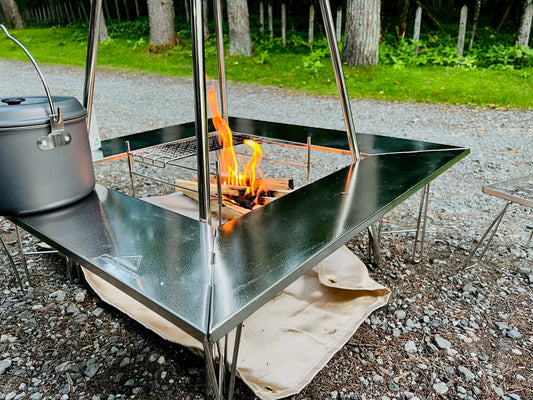
I recommend setting Imabari firewood in the fire pit, starting a spark with a fire starter, and gradually adding smaller pieces of wood to the fire.
Conversely, if you're using a burner or lighter to start a fire, you can efficiently build a bonfire by first placing large logs under the fire pit and then lighting the Imabari dust.


Apparently, the dust from Imabari was the catalyst for the creation of MAGIC HOUR.
The brand owner has been a camping enthusiast for many years. He was inspired by the large amount of dust that is discarded every day. The product was created thanks to his broad perspective and flexible thinking. This is the beginning of an outdoor brand. We look forward to seeing what happens next.